Reading your own blood work
The range on your lab report was not built for you. It was built from everybody else.
Two labs can print the same testosterone result and disagree about what it means. The reason is in how that band gets drawn.
The results come back and the word at the end of the line is normal. Nothing is flagged. The visit lasts four minutes, the paper goes in a drawer, and that is the end of it. For most men that is the right outcome. What almost nobody gets told is what that word was actually measuring.
It was not measuring you. It was measuring the distance between your number and the middle of a reference group that the laboratory chose, on criteria that have nothing to do with you. That is not a criticism of the laboratory. It is the definition of the thing, and it is written down in the standards the laboratory follows.
Below is how that group gets picked, why two respected laboratories can draw the line in two different places, what a second number does that the first one cannot, and what any of it is worth to a man who feels fine on paper and flat in real life.
A reference range is a percentile, not a verdict
Start with the definition, because the definition is doing all the work here. From a 2024 paper in the Journal of Clinical Medicine on how laboratories verify their own limits:
By definition, reference intervals include the central 95% of results measured in non-diseased reference individuals. Journal of Clinical Medicine, 2024 · full text
The same paper describes how the two numbers get produced: laboratory results are collected from apparently healthy individuals, and the 2.5th and 97.5th percentiles of that distribution become the lower and upper limits. Everything between them is printed as normal.
Read that once more with a calculator. If the band is the middle 95 percent of a reference group, then one person in forty from that same healthy group falls below the lower limit, and one in forty falls above the upper one, purely by construction. Nothing has gone wrong. The band was built to leave them out.
This is why a laboratory report can only ever answer one question: is this result unusual for the group we compared it with. It is a good question. It is not the same question as whether the number is a good one for the man holding the paper.
Change the group, change the number
If the limits are percentiles of a group, then the choice of group is the whole ball game. Two respectable answers to the same question, both published, both current:
Quest Diagnostics
Lower limit for adult men aged 18 and over: 250 ng/dL.
Group: a healthy population of men up to age 90. The limit is the 2.5th percentile of that distribution, measured by mass spectrometry.
Harmonized reference range
Range for healthy nonobese men aged 19 to 39: 264 to 916 ng/dL.
Group: four cohort studies in the United States and Europe, pooled and standardized. Median of that group: 531 ng/dL.
Quest Diagnostics, clinical education center, testosterone FAQ. Travison et al., Harmonized Reference Ranges for Circulating Testosterone Levels in Men of Four Cohort Studies in the United States and Europe, cohorts: Framingham Heart Study, European Male Aging Study, Osteoporotic Fractures in Men Study, Male Sibling Study of Osteoporosis.
Quest does not hide the problem. On the same page, in the answer about where the cutoff for testosterone deficiency should sit, the laboratory writes it plainly:
The population defining the TT reference range, and thus the T-deficiency cutoff, has been debated. Quest Diagnostics, clinical education center
So take a man of 38 with a result of 300 ng/dL. It is inside the Quest band, because that band was drawn from men up to the age of ninety. It is inside the harmonized band, because that band starts at 264. And it sits just below the 5th percentile of healthy nonobese men his own age, whose middle value is 531. All three statements are arithmetic. Only the first one is printed on the sheet, and only the first one gets read out loud in the appointment.
The tube is the same. The method is not.
There is a second source of movement in that number, and it has nothing to do with statistics. It is the assay. The Endocrine Society recommends measuring total testosterone by liquid chromatography with tandem mass spectrometry. Most routine testing has historically used an immunoassay instead, and Quest describes the difference in one sentence:
Immunoassay produces reliable results for normal or elevated levels of total testosterone but lacks sensitivity, specificity, and precision at lower concentrations. Quest Diagnostics, clinical education center · condensed from the published answer
Mass spectrometry
The reference method for total testosterone endorsed by the Endocrine Society.
Quest reports its assay as certified by the CDC Hormone Standardization Program, with a reportable range of 1.0 to 10,000 ng/dL.
Immunoassay
Historically the platform of choice, and still the routine one.
Reliable at normal and elevated levels. Loses sensitivity, specificity and precision at low concentrations.
Read the shape of that sentence. The cheaper method is at its weakest exactly where the decision gets made. Quest states that in men with low levels, total testosterone should be measured only by mass spectrometry, and that its own mass spectrometry assay is certified by the CDC Hormone Standardization Program. Two men can hand over identical blood and walk out with different numbers, and neither of them will ever know which method was run unless somebody looks.
One number is really three
Total testosterone is a sum. Quest breaks the circulating total into three parts:
SHBG is the variable in that picture. When it moves, the split moves with it, and the total on the sheet can stay exactly where it was. Quest is explicit about when the second measurement earns its place: free testosterone is helpful when the total sits near the decision level, or when a shift in SHBG is likely. It also notes that free and bioavailable testosterone cannot be measured directly at all in routine practice, so the figure is calculated.
None of this is exotic. It is the standard content of a laboratory education page. It just does not fit in a four minute appointment, and it is not printed next to the word normal.
What Marek Health does with the same sheet
Marek Health is a telehealth platform built around this exact gap. Not around the drug, around the reading. It is worth quoting their own answer on hormone therapy eligibility, because it says the quiet part in public:
The ranges we have for hormone health changes between labs but they're also largely arbitrary and don't paint the whole picture of what's going on. Marek Health, frequently asked questions
On their testosterone page, one of the four things they position themselves against is not a competitor. It is a document: oversimplified lab value ranges. The other three are disinterested doctors, outdated treatment protocols and stubborn insurance companies.

What their panels look at
Their published panel categories, in their words:
Cognitive performance
Nutrient levels, inflammation markers, hormone balance, metabolic health, neurotransmitter activity, oxidative stress, antioxidant status and genetic variants.
Heart health
Lipid profiles, inflammatory markers, homocysteine levels and other cardiovascular indicators.
Sexual wellness
Detailed hormone panels measuring testosterone, estrogen, DHEA and other markers.
Sleep and recovery
Cortisol patterns, melatonin precursors and other biomarkers that influence sleep quality and recovery.
Weight and metabolism
Metabolic testing covering thyroid function, insulin sensitivity and hormonal factors.
And then a person
Every client gets a health coach and a 25 minute consultation with a licensed medical provider to go through the report line by line.
Panel categories as published on marekhealth.com/get-started, read August 14, 2026.
The four steps, as they describe them
Establish your baseline
An intake call with a Marek Health coach to go through symptoms and goals, and to build a custom lab panel rather than a fixed one.
Build your direction
Results come back as a written report with recommendations, instead of a set of numbers with a word next to them.
Optimize with guidance
A 25 minute consultation with a licensed medical provider, then monthly coach check-ins and follow-up lab work.
Track what changes
Progress is measured over 12 weeks, which is the only way to know whether anything moved.

The reason the company exists
Derek, co-founder of Marek Health and host of the More Plates More Dates channel, put it this way on the company's own home page:
“Over time, I found it incredibly difficult to get medical oversight for myself and my family that reflected the most cutting-edge literature, and that was preventative, that's why I started Marek Health.”

Marek Health is careful about what it is, and the distinction is on their own FAQ page: they are not a clinic. They describe themselves as a platform that connects clients with specialized healthcare providers, and the providers do the prescribing. That is a narrower promise than most of the category makes, and it is the honest one.
See how Marek Health reads a panel Guided Optimization on marekhealth.com · United States residents onlyThis page is an independent explainer. The link goes to Marek Health.
Ten weeks, in their clients' words
The photographs below are published by Marek Health on its home page under the heading real client results in just 10 weeks. The reviews are reproduced from their own site with the names and dates they display, and every cut inside a quote is marked.
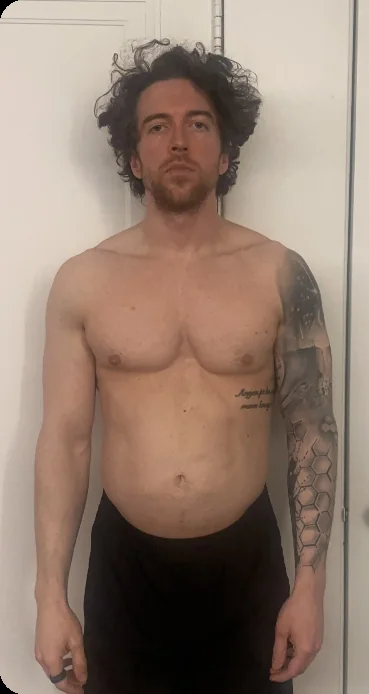 Dylan R. before
 after 10 weeks
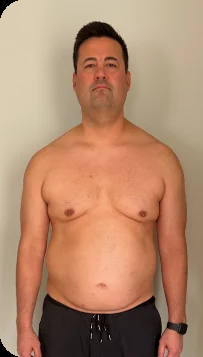 Richard O. before
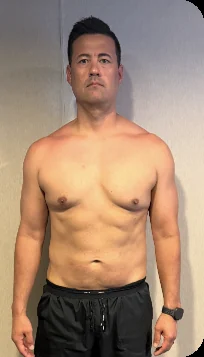 after 10 weeks
I waited too long to seek hormonal health (optimization). The symptoms crept into my life so slowly, that made me think it was a “normal/natural” part of aging. I'm only 42. [...] There must be a LOT of men experiencing what I felt. Stop the taboo, get some help. Seriously, you need a tailor-made approach TO YOU!, no cookie-cutter care from a Hormone Replacement Clinic in your town.
This is the most personalized trt/hrt you can get. Truly a blessing to work with in today's trt tele doc era.
I can't say enough about what a help and benefit Marek has been for my health and performance optimization. At 43, I've never felt better.
Eric went above and beyond explaining stuff in detail about TRT & other treatment options.
Life Changer. Marek's team and solutions are nothing short of life changing. In 2.5 months I've lowered my cholesterol 100pts, lost 20lbs, and gained all the knowledge and tools necessary to battle a bad diet and sleep habits. [...]
Reviews reproduced from marekhealth.com as published on August 14, 2026. Individual experiences are individual. Marek Health displays a 5.0 Trustpilot score from 820 or more reviewers on its own get-started page.

 Sean BradyUFC welterweight
 Stan EfferdingCelebrity and athlete coach
 Jordan SyattHealth and fitness expert
What it costs, and who it is not for
Worth knowing before the call, because the model is unusual and the numbers are published:
- A minimum lab panel purchase of $450 applies, at discounted pricing unlocked at the assessment.
- Includes the coach assessment, the written lab analysis, and a 25 minute consultation with a licensed medical provider.
- Monthly coach check-ins, follow-up lab work and refills are part of the ongoing program.
- Direct pay only. Marek Health does not communicate with health insurance companies. Many clients pay with HSA or FSA funds.
- United States residents only. Marek Health states it cannot service clients outside the US.
That is a real cost, and it buys a specific thing: somebody whose job is to read the whole sheet with you rather than the flagged lines. Whether that is worth it depends entirely on whether you have ever left an appointment with the word normal and the feeling that it did not answer the question you came in with.

- A reference range is the middle 95 percent of a group. One healthy person in forty sits below it before anyone is examined.
- The group is a choice. Men up to 90 in one published range, healthy nonobese men aged 19 to 39 in another.
- The method moves the number too. Immunoassay loses precision at exactly the concentrations where the decision is made.
- The total hides three fractions, and the free one is 1 to 4 percent of it.
- None of that is on the sheet. It takes a person and 25 minutes.